AI visibility tools measure how AI assistants such as ChatGPT, Claude, Gemini and Perplexity talk about your brand. They do it with one of two prompt types:
- Real user prompts are prompts people actually typed into an AI assistant, captured from real sessions.
- Synthetic prompts are prompts you decide to track, whether or not you have evidence that customers type them.
In this post, I compare the pros and cons of each for AI prompt tracking. It's based on a year of prompt tracking for several CommonMind clients and on testing six different AI visibility tools.
My short answer is that most B2B companies should track synthetic prompts. Real user prompt data is thinner and harder to verify than it looks. However, large brands with broad demand may still get value from tracking real user prompt data.
Tracking Real User Prompts
Tools that track real user prompts have access to actual prompt data from users. This would seem ideal. Don't you want to know which prompts people are actually typing into ChatGPT, Claude, etc. to find your business? I sure would.
However, tracking real user prompts is less reliable than it appears on the surface. Before relying on the tools, we need to ask: where are they getting the prompt data and can we trust it?
Profound is the biggest player in this space. It licenses its data from a data broker that collects prompts and conversations users have agreed to share.
Chatting with an AI can be a personal experience, and I can't imagine sharing my ChatGPT or Claude sessions with a third party, and for this reason, I'm skeptical that Profound's prompt data is representative of my target audience, or those of my clients, which tend to include niche buyers.
According to Profound's Prompt Volumes FAQ, Profound receives tens of millions of real prompts each month. While that sounds impressive, ChatGPT was already receiving 2.5 billion prompts per day as of July 2025.
Based on ChatGPT's market share of 46%, we can extrapolate that roughly 163 billion queries are prompted by users across the major LLMs each month.
Taking Profound's "tens of millions of real prompts" claim at face value and assuming they have access to 90 million prompts monthly, they have access to roughly 0.06% of the real user prompts, weighted towards lower-value users who have opted into sharing their prompt data.
My worry is that a panel that accounts for 0.06% of prompts won't be representative of specialized buyers' questions, and this worry is borne out in a screenshot I share further below.
To be fair, Profound also tracks synthetic prompts, and its real user prompt data helps customers choose which ones to track.
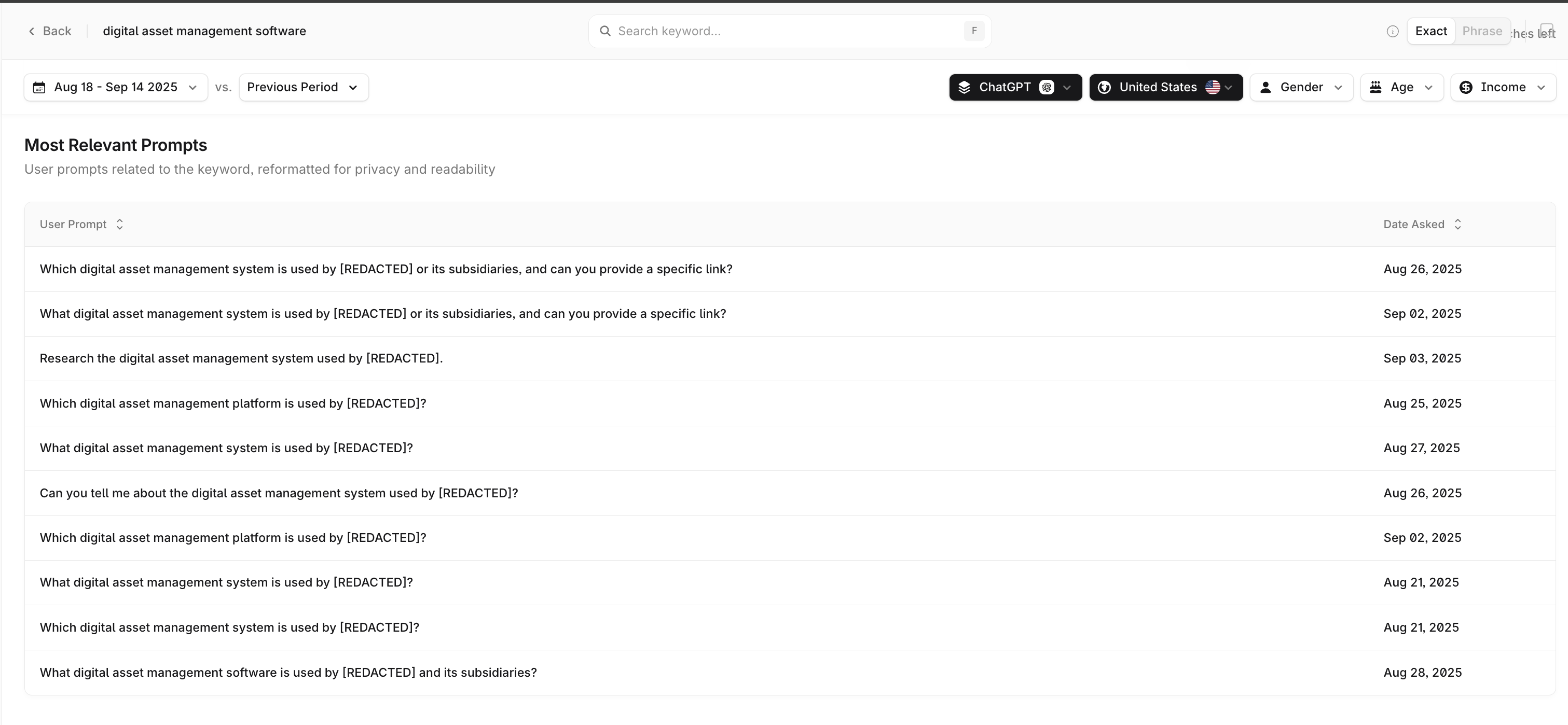
Here is a screenshot of Profound's report of real user prompts for a B2B SaaS topic so you can judge the usefulness for yourself, bearing in mind that this is from 2025 and Profound's reporting has likely improved further.
Microsoft's Bing Webmaster Tools
Another tool that provides insights into real AI usage is Microsoft's Bing Webmaster Tools, specifically its AI Performance Report.
Microsoft's data is more directly sourced than Profound's because it is aggregated from Microsoft's own tools (Microsoft Copilot, AI-generated summaries in Bing, and select partner integrations). Bing Webmaster Tools has another advantage: Microsoft provides this reporting for free.
However, unlike Profound, which shows real user prompts, Microsoft displays its prompt data as "grounding queries," which are "grouped representations from your site that were retrieved and cited in AI-generated answers. They are not full user questions or prompts."
Another key difference between Profound and Microsoft's AI Performance Report is that Microsoft is reporting on citations whereas Profound provides reporting on both citations and mentions.
A citation occurs when an LLM cites your website as a source.
A mention occurs when an LLM mentions your brand name.
It's important to understand the difference between citations and mentions and their relative value for your business. Let's look at an example:
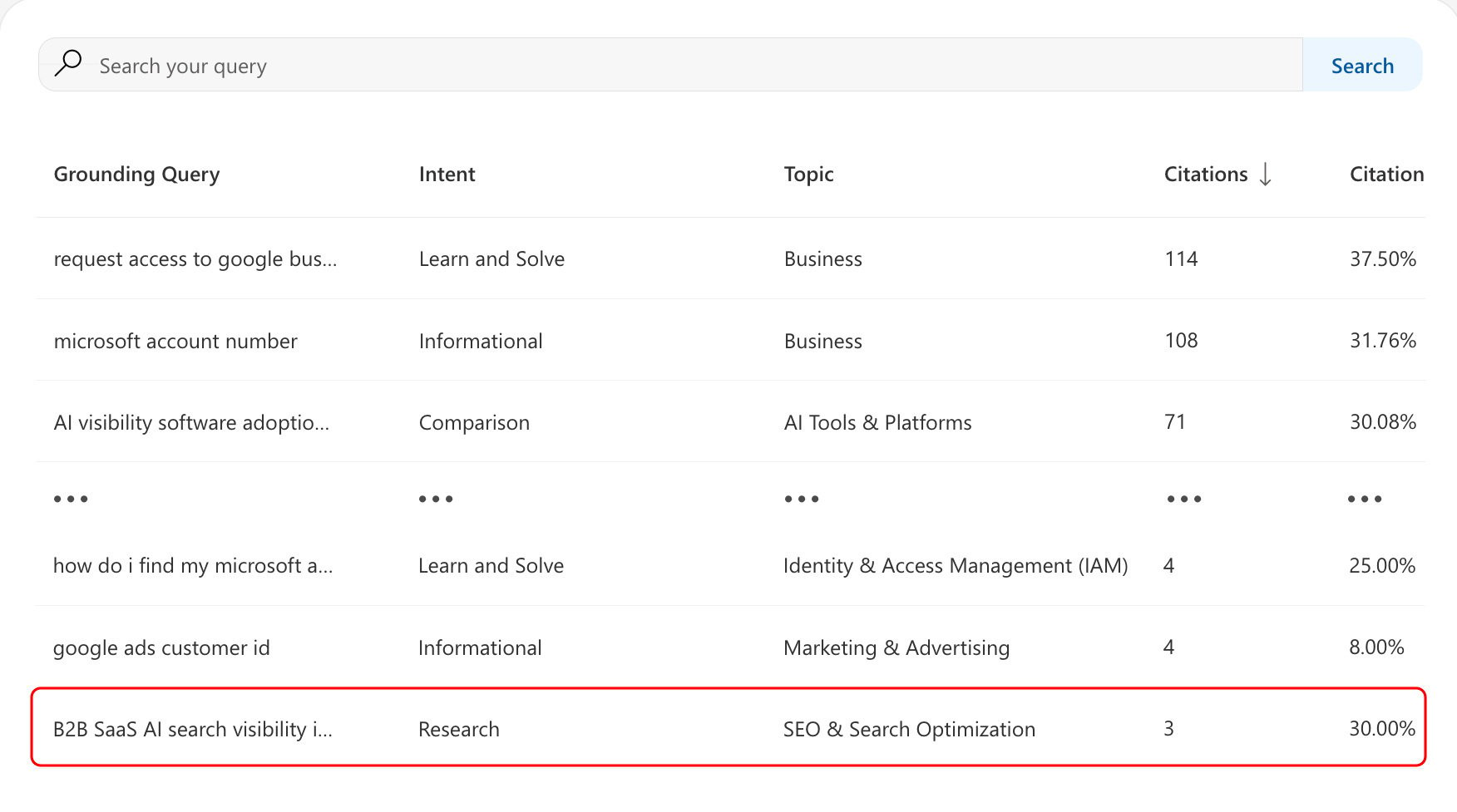
As shown in the screenshot above, from Bing Webmaster Tools' AI Performance Report, the CommonMind website is cited as a source for the grounding query "B2B SaaS AI visibility importance."
Here are example results for a prompt that may be associated with the grounding query above:
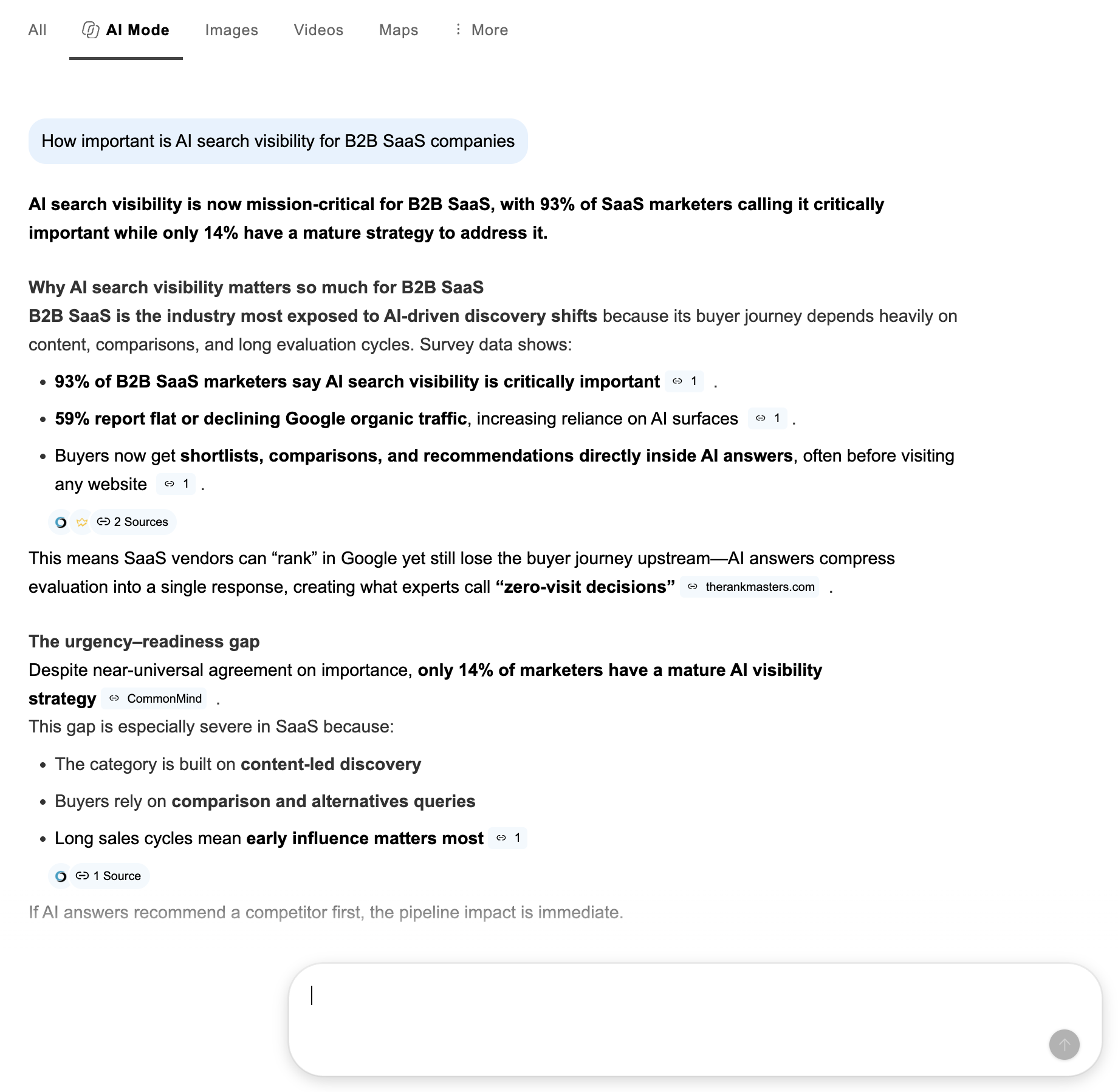
As you can see, the prompt I used was "How important is AI search visibility for B2B SaaS companies" and CommonMind is shown a few times as a source for the answer. Outside of the source attribution, CommonMind isn't mentioned in the actual answer provided by Bing's AI.
In most cases, a brand mention is more valuable than a citation because it's easier for the user to gloss over the citation. In our example, CommonMind is cited twice and in one instance, our full name is included as part of the citation. In another instance, the user would need to mouse over the link icon to see our name.
In summary, both Profound and Bing Webmaster Tools have limitations when it comes to reporting on AI visibility:
- In the case of Profound, the limitation is due to its data source being a sample of unknown provenance.
- In the case of Bing, it's due to how Bing summarizes data and restricts reporting to citations rather than both citations and brand mentions.
Tracking Synthetic Prompts
On the surface, tracking synthetic prompts seems less valuable than knowing real user prompts. However, in practice, if you know your customers well and give sufficient thought to the prompts you construct, you can usually approximate user behavior with this approach.
The best way to come up with synthetic prompts that are valuable to track is to talk to your sales and customer success teams to find out:
What questions are real customers asking your frontline professionals?
In all likelihood, your customers are asking those same questions to ChatGPT or their favorite LLM.
Where synthetic prompts fall short
While I believe tracking synthetic prompts can give you a fair representation of your brand's AI visibility, synthetic prompts also come with limitations:
- There isn't any guarantee users are typing these prompts unless a customer tells you directly it's a prompt they used.
- LLMs customize their responses based on what they know about a user, including memory and past chats. Therefore, while a generic ChatGPT response may include your brand, it doesn't mean that a specific user's ChatGPT response will mention your brand.
- LLM responses are based on probabilities, which are seeded with randomness. Therefore, even two back-to-back prompts from the same user can generate different responses.
In an upcoming article, I will discuss different approaches to coming up with synthetic prompts to mitigate these limitations.
Most of the AI visibility tools in the marketplace are based on tracking synthetic prompts, including three of the tools I reviewed in my webinar on 5 AI SEO Tools Exposed: Promise vs Reality.
As of this writing (October 2026), the three AI visibility tools I'd shortlist are AI Trust Signals, Visto, and HubSpot's AEO software, all of which only track synthetic prompts and provide recommendations for improving your brand's AI visibility.
Real vs. Synthetic Prompts at a Glance
|
Real user prompts |
Grounding queries |
Synthetic prompts |
|
|---|---|---|---|
|
Tools |
Profound Prompt Volumes |
Bing Webmaster Tools AI Performance report |
Visto, AI Trust Signals, HubSpot AEO, Profound Answer Engine Insights, others |
|
Where the data comes from |
Opt-in consumer panels, modeled into volume estimates |
Microsoft Copilot, AI-generated summaries in Bing, select partners |
Prompts you write, run on a schedule across AI assistants |
|
What you see |
Real prompts (reformatted for privacy) and estimated volume |
Grouped "grounding queries," not the prompts users typed |
Synthetic prompts and each AI assistant's answer |
|
Shows how often people ask |
Yes, estimated prompt volume |
No, only how often you're cited |
No, you judge which prompts matter |
|
Brand mentions |
No, Profound tracks mentions with synthetic prompts |
No |
Yes |
|
Citations |
Partly, a sample of prompts that cited your pages or a competitor's |
Yes |
Yes |
|
Sees prompts where you're absent |
Yes |
No, only where you're already cited |
Yes, if you track them |
|
Fit for niche B2B buyers |
Weak, the sample is thin for specialized buyers |
Weak, only queries where you already appear |
Strong, you write prompts for your exact buyer |
|
Biggest weakness |
Who joins consumer panels |
Summarized, sampled, citations only |
Reflects your assumptions about buyers |
|
Cost |
Paid |
Free |
Paid |
Taking Action to Track Prompts for Your Brand
If you have a large brand (think Fortune 1000), and you feel it's important to track real user prompts, do a demo of Profound and see if the prompts it surfaces seem representative of your customer base. Otherwise, pick a tool that focuses on synthetic prompts, such as one of the ones listed above, and do the hard work of constructing prompts that are representative of your customers and prospective customers.
Want to see where your brand shows up in AI answers, and which competitors AI recommends? Request a free AI Visibility Snapshot.
Sources
- Profound, "Prompt Volumes FAQ," Profound documentation, accessed October 22, 2026.
- Amanda Silberling, "ChatGPT users send 2.5 billion prompts a day," TechCrunch, July 21, 2025.
- Ivan Mehta, "ChatGPT's market share slips below 50% for first time," TechCrunch, June 16, 2026.
- Profound, "Create, manage, and tag prompts in Prompt Designer," Profound documentation, accessed October 22, 2026.
- Microsoft, "AI Performance in Bing Webmaster Tools," Bing Webmaster Tools Help, accessed October 22, 2026.
Share this

The 2026 State of AI Visibility in B2B SaaS: 5 Data-Backed Shifts

What Kind of Offers Should I Promote on LinkedIn?