.svg "Group 139 (1)")


If you and someone else search the same thing on Google, you probably expect to see roughly the same results.
There have always been differences. Google considers things like location, language and device, and local searches have always been especially sensitive to where the searcher is. But recent research suggests those differences may be getting bigger, particularly in organic search.
In June 2026, Schieler De’Land of Service Lifter published an observational study after running the same searches across different logged-in Google profiles. He found surprisingly different results and proposed what he called the “Dynamic SERP Personalization Theory”: the idea that Google may increasingly be serving different search results based on the individual searcher and their context.
It was an interesting observation, but the experiment was relatively small. De’Land wasn’t the only SEO professional noticing unusual behavior. Joy Hawkins of Sterling Sky reported similar patterns and found other SEO professionals seeing the same kind of SERP variation. She then worked with Yext to investigate the phenomenon using a much larger dataset.
Since then, a much larger study has found evidence that something really did change in Google Search around May. Whether personalization is the reason is still an open question.
What Changed in May?
In September, Yext published an analysis of more than 8 million location-specific Google search result snapshots collected between January and August 2026.
Researchers compared results for the same searches performed from different geographic points. Starting around mid-May, mobile organic results began varying much more depending on search location.
The differences were significant:
- Geographic variation in mobile organic results increased 48.7%.
- 97.8% of the matched reports showed increased variation.
- Searches containing an explicit location saw a 76.3% increase.
- "Near me" searches saw a 30.2% increase.
- Mobile Maps and Local Pack results changed by less than 3%.
This wasn't simply the usual ranking fluctuation from one week to another.
Yext also compared results from the same location over time. That variation increased by just 7.5%, far less than the 48.7% increase seen when comparing different locations.
In other words, it wasn't just that rankings became more volatile.
Where someone searched from appeared to have become a bigger factor in which organic results they saw.
Interestingly, the first signs appeared around May 18, shortly before Google's May 2026 core update began on May 21. The timing overlaps, but there isn't enough evidence to say the core update caused the change.
Does This Mean Google Is Personalizing Every Search?
Not necessarily.
This is where the difference between dynamic search results and personalized search results matters.
Google openly acknowledges that personalization exists. Its documentation says Search can use information including previous activity, interests and general location to provide personalized recommendations. Current context can also influence what users see.
So the idea that two people can receive different Google experiences isn't new.
But that doesn't prove personalization caused the change researchers observed in May.
In fact, Yext's study used logged-out searches without click history. Its research measured geographic variation, not individual personalization.
That's an important distinction.
The original Dynamic SERP Personalization Theory may have identified a real change in Google's search results without necessarily identifying the mechanism behind it.
At this point, a safer conclusion is:
Google's organic results appear to have become more dynamic, particularly on mobile and for searches with local intent.
Why that is happening is still being investigated.
We Looked at Our Own Client Data
After seeing the research, we wanted to know whether we could spot similar patterns in data we already had.
We reviewed Google Search Console, organic rank tracking and historical Local Search Grid data for one of our multi-location clients.
This isn't a controlled study, and our sample is nowhere near large enough to prove what's happening across Google Search. But we found some interesting similarities.
First, we looked at queries appearing in Google Search Console both before and after the change observed in May.
Geographic queries showed considerably more ranking movement than non-geographic searches:
| Query type | Average position movement |
|---|---|
| Geo-related queries | 3.55 positions |
| Non-geo queries | 2.08 positions |
| Geo + non-brand queries | 3.83 positions |
In our sample, geo-related queries therefore moved about 70% more than non-geographic queries.
Importantly, this wasn't simply a case of all the local rankings getting worse.
Some improved substantially while others fell. Among non-brand geographic searches, the overall direction was almost neutral even though individual rankings moved considerably.
That looks more like reshuffling than a straightforward ranking loss.
The Same Keyword Could Rank Very Differently Nearby
Our location-based organic rank tracking showed another interesting pattern.
For keywords monitored from multiple locations, the average difference between the client's best and worst observed organic position was more than six rankings.
Some individual searches showed much larger differences, including one keyword that appeared at #1 from one tracked location and #26 from another.
And these weren't searches being compared across opposite sides of the country.
Nearly all of the locations included in this part of our analysis were on Long Island. That makes the differences particularly interesting: relatively modest changes in search location could correspond with very different organic rankings.
This is also why a single ranking report may not tell the whole story.
A rank tracker reporting position #2 isn't necessarily wrong. Google may genuinely have returned that result from the location the tool checked.
The question is whether #2 is representative of what searchers elsewhere in the market are seeing.
Maps Told a Different Story
We then looked at historical Google Maps rankings using a Local Search Grid.
If Google had simply become much more geographically volatile across the board, we might expect to see a similar pattern there.
We didn't.
For one explicitly localized query, "summer camp purchase," the client's average Maps position across 25 geographic points was:
| Date | Average Maps position |
|---|---|
| March 25 | 1.0 |
| May 13 | 1.1 |
| June 23 | 1.1 |
| August 12 | 1.1 |
Individual points across the grid were similarly consistent.
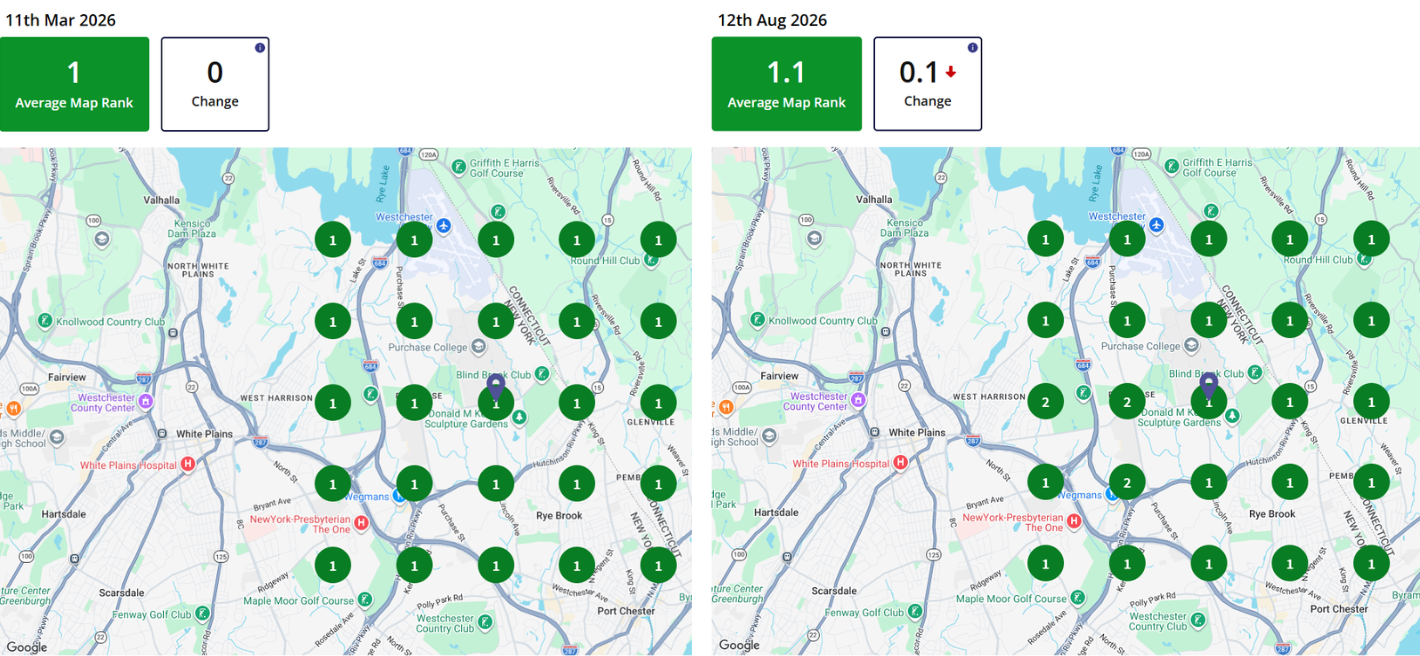
We found the same general pattern when looking at a "near me" query. Maps visibility remained relatively stable after May rather than becoming dramatically more geographically variable.
That's notable because it broadly mirrors Yext's much larger dataset. The major increase they identified appeared in organic search, while Maps and Local Pack results changed very little.
Again, our sample is far too small to validate those findings.
But seeing the same general distinction in our own data is interesting.
So, Are Keyword Rankings Becoming Less Reliable?
Not exactly.
Rankings still matter. What's becoming less reliable may be the assumption that there is one ranking for a keyword.
Google itself notes that you may not reproduce a Search Console ranking by searching for the query yourself because results depend on factors including time, place, device and the searcher's recent history.
A rank tracker is essentially taking a snapshot under a particular set of conditions.
If Google's results are becoming more context-dependent, that snapshot can still be accurate while being less representative of what the entire audience sees.
That changes how we should interpret SEO reports.
Instead of looking at a keyword ranking in isolation, it becomes increasingly important to consider Search Console impressions and clicks, organic traffic, conversions, visibility across important locations and overall trends.
For local and multi-location businesses in particular, tracking from multiple geographic points may also provide a much better picture than checking rankings from one location.
The question isn't only:
"Where do we rank?"
Increasingly, it may also be:
"How consistently are we visible when the right people search?"
What Should Businesses Do Differently?
For now, there's no reason to overhaul an SEO strategy because of this research.
The fundamentals haven't changed. Businesses still need useful content, technically sound websites, relevant local pages and strong signals that help Google understand what they offer and where they offer it.
What may need to change is how SEO performance is measured.
Be cautious about drawing major conclusions from one keyword moving from #2 to #5 in a rank tracker. Look for patterns across multiple keywords, locations and data sources.
And, most importantly, connect rankings back to actual business results.
Search Console clicks, qualified organic traffic, leads, calls and conversions ultimately tell us much more than whether one tracking tool saw a website in position #2 or #4 on a particular day.
Yext's research found that the increased geographic variation continued through June and July, suggesting this wasn't simply a few days of volatility surrounding an update. At the same time, the researchers couldn't determine which Google system caused it.
So Dynamic SERP Personalization remains a theory, not a confirmed Google update.
But the broader observation behind it is becoming harder to ignore:
There may no longer be one Google ranking that accurately represents what everyone sees.
And that has important implications for how businesses and SEO teams measure search visibility.
Share this

Google’s Responsive Search Ads: Best Practices & How-To

What SEO Tactics Actually Work? Comparing a Major SEO Study With Our Own Results